
Picture your next big SaaS renewal that you’ve got coming up. The account rep walks you through usage and a price increase, you push back on the number for a while, and eventually everyone settles on something they can live with. Then someone on your side mentions the AI agent your team wants to connect to that system, which is when the rep starts asking how the agent will get in and what that kind of access should cost.
It’s a strange thing to negotiate over data your own company created, especially since getting it out of a SaaS app and into a warehouse or another tool has always been a job for your engineers rather than a line on the invoice. What’s different now is the volume. A person might pull a report once a week, but an agent can hit the same system thousands of times a day, and vendors have started looking at that traffic as something to control, charge for, or both.
Slack was one of the first places customers ran into this. When Salesforce tightened what outside tools could do with Slack data and cut off bulk exports, companies that used tools like Glean to search years of Slack conversations were left with a much narrower, real-time view, even though every one of those messages was written by their own people.
SAP, ServiceNow, and Workday Are Metering AI Agent Data Access
SAP went further. In June it began enforcing a policy that routes third-party AI agents and bulk data extraction through its own gateway, which left customers with older extraction pipelines rebuilding them on SAP’s terms. Forrester warned CIOs against letting any single vendor become the gatekeeper for their AI, and flagged SAP’s approach as a potential pricing cliff.
ServiceNow and Workday are heading the same way with different mechanics. ServiceNow now meters outside agents through its own governed layer, and Workday bills credits for the work agents do, including retrieving data. When a JPMorgan analyst looked at ServiceNow’s version, he described it as effectively a tax on customers who bring their own AI.
Vendors do carry real costs when agents hammer their APIs, and they’re entitled to price for that. The trouble lands on your side of the table, because if every AI project you’ve planned runs through a vendor’s API, the vendor gets a lot of say over what those projects end up costing, and you don’t have much room to push back at renewal.
4 Ways Data Access Pricing Exposes Your AI Strategy
When we wrote The AI Data Readiness Playbook, we broke AI-ready data into four parts: ownership, preservation, structure, and access. We built that framework to explain why so many AI projects stall, but it maps closely onto this problem too, since a change in a vendor’s access rules can expose a weakness in any one of them. It’s worth walking through all four with a single system in mind, and for most people reading this, that system is Salesforce.
Data Ownership: Your SaaS Data Lives Somewhere You Rent
Picture the vendor behind your most important system turning off third-party API access first thing on a Monday. For a lot of companies, the honest list of what breaks would be long: the dashboards leadership checks every week, the syncs that keep marketing and finance working from the same numbers, and almost certainly whatever AI pilot got funded this year. Very few teams keep a current copy of that data anywhere they control, which is exactly why a new access fee is so hard to turn down when it shows up in a renewal.
The leaders we surveyed for the playbook seem well aware of this. Out of 30 senior data and IT leaders, keeping data on infrastructure they control came out as the strongest reason to buy, well ahead of anything else we asked about, and nine in ten said a platform’s own data tools wouldn’t remove the need for an independent copy.
Salesforce Field History: What You Don’t Keep Is Gone for Good
Say someone asks an AI agent why win rates fell in one region last year. A good answer depends on how those deals actually moved, including when stages changed, when discounts crept in, and how many times a close date got pushed, and most systems don’t hold onto that. They keep the current version of each record, and in Salesforce, field history can age out after 18 months.
If your plan for history today is a handful of exports in a shared drive, a tighter access policy turns that gap into a permanent one. You can always negotiate a better contract later, but you can’t go back and capture three years of field changes you never saved.
Keep every field change
Capture Salesforce history before it ages out for good.
Proprietary Backup Formats: A Backup You Can’t Read Is a Second Bill
Plenty of companies do have a backup, and it gives them real peace of mind right up until someone tries to use it for something beyond a restore. Backups are usually built to be compact and quick to recover, which often means a format only the backup vendor’s tools can open. If reaching the live system gets more expensive, a copy in open, analytics-ready formats lets your warehouse and AI tools keep running on data you’ve already paid to store, while a locked copy leaves you paying again just to make it usable.
API Costs for AI Agents: Nobody Budgeted for the Meter
Most AI business cases account for the model, the compute, and the people, then quietly assume the data will be there whenever the agent asks for it. That assumption gets expensive fast, because an agent answering questions all day makes thousands of calls where an analyst running a weekly report makes a handful.
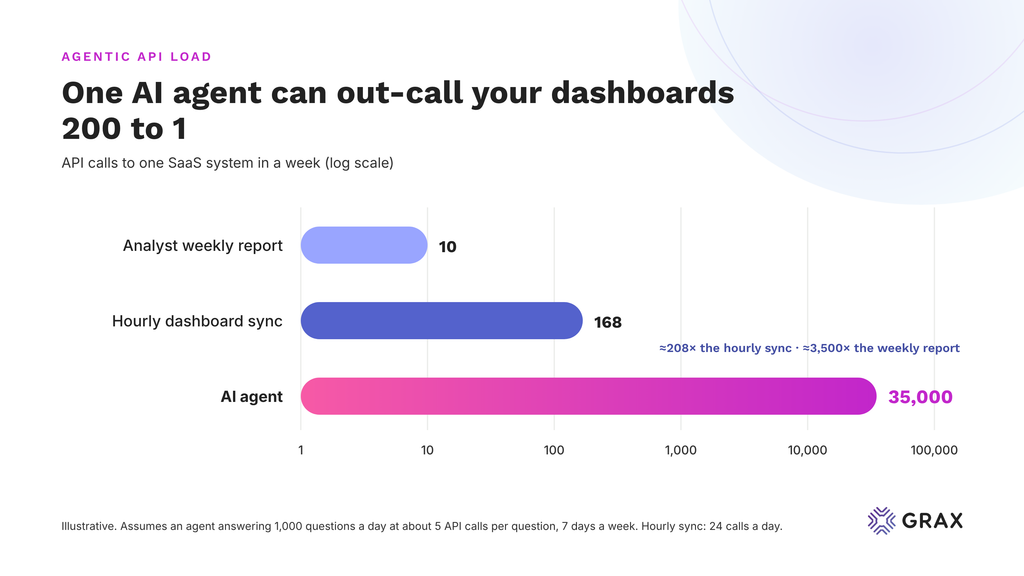
Snowflake’s AI pricing gives a sense of the scale. Since April it has charged for AI usage through credits, at around 13 cents for a typical interaction, and one estimate puts an unmanaged setup answering 1,000 questions a day at roughly $22,000 a month before warehouse compute. That’s AI usage rather than a data access fee, but it shows what happens to a budget once every query has a meter on it, and it’s worth asking which projects on your own roadmap would look very different if your vendors’ APIs started working the same way.
How to Prepare for SaaS Data Access Fees
If you read through those four and felt fine about all of them, you’re in better shape than most. If one of them made you a little uneasy, there are two things you can do this quarter that will tell you a lot. The first is to open the contract for your next major renewal and search it for “API,” “export,” and “agent” before the vendor’s account team brings any of it up, so new terms get negotiated rather than simply accepted. The second is to pick one Salesforce object your AI plans depend on, like Opportunity or Case, and run it through the scorecard in The AI Data Readiness Playbook. It takes about an afternoon and shows you exactly where you’d be exposed.
Vendors are going to keep changing how they price access, and some of those changes will be perfectly reasonable. The companies that come out ahead will be the ones that still have options when it happens.
Find out where you stand before your vendor tells you
Most companies only learn how exposed they are when a renewal quote lands on someone’s desk, and by then most of the leverage is gone. You can find out on your own schedule instead. The AI Data Readiness Playbook includes a one-page scorecard built for exactly this, and it walks you through ownership, history, format, and access for a single Salesforce object in about an afternoon. You’ll come out of it knowing which of your AI plans depend on access you don’t control, and what you’d want to change before that turns into a pricing conversation.
Get your AI Data Readiness Playbook
Find out where your Salesforce data is exposed to access fees.
If you’d rather talk it through with someone, book time with the GRAX team. We’ll help you score your first object and show you what it looks like to keep a full, usable copy of your Salesforce data on infrastructure you own.