
As Salesforce environments continue to grow in volume and complexity, the need for tools to protect sensitive information, maintain compliance, and manage and deploy data has never been this important. A compliance gap or failed deployment can cost businesses far more than money; it can waste time and even cost them their credibility. This is why the choice of the right solution that suits your organization’s workflow and growth projection is one that must be made carefully.
GRAX and Gearset are two platforms that come up often in the Salesforce ecosystem. While these two platforms address data protection, they are essentially built with different objectives in mind. This article highlights the difference between these two Salesforce solutions, how they operate, their strengths, and the type of organization each solution is best suited for.
GRAX vs Gearset
GRAX and Gearset are both leading Salesforce solutions that help organizations handle different problems. It is important to understand what each platform is all about and who it was designed for before comparing its specific features.
GRAX
GRAX is a Salesforce data management platform that focuses mainly on data ownership and control. It helps organizations in backing up information, archiving its inactive records, recovering lost data, and making reuse of Salesforce data possible. The platform’s major emphasis is to help organizations address limitations associated with long-term management of data, its retention and accessibility.
GRAX does this by consistently replicating large volumes of Salesforce data to a customer-controlled cloud environment, which includes Azure, AWS, and GCP, or an on-premises environment. It provides organizations in regulated industries with a verifiable chain of custody and compliance requirements related to audit readiness and data retention.
Gearset
Gearset is a full feature salesforce Dev Op platform designed to help teams implement best practices across every DevOps lifecycle. It was built to be the single platform a salesforce team needs to safely and efficiently implement a change from ideation to production. Gearset caters to a broad area of needs, which includes: metadata deployments, peer code review, CI/CD pipeline automation, static code analysis, sandbox environment management, and sandbox seeding with realistic data.
The platform also incorporates an AI feature known as the Gearset Agent that helps organizations identify issues, optimize pipelines, and gain intelligent insights that would have required manual investigation. That’s not all; Gearset also performs automated data backups, granular recovery and compliance-ready audit trails.
Your Salesforce Data Deserves More Than a Backup
See how GRAX gives you full ownership and control in your own cloud.
Pricing and Features
GRAX
GRAX offers two plans and a 7-day free trial on its website. These plans include;
- Continuous plan (most popular plan)
- Continuous + Intelligence Plan
The price for each of the plans is not publicly listed on the official website as prices are calculated based on varying individual factors, such as volume of data, retention requirements, deployment preferences and capabilities required. Businesses interested in any of the plans are usually required to book a consultation with the GRAX team in order to receive a custom quote based on their preferences.
GRAX offers amazing features such as point-in-time recovery, continuous daily backup, granular recovery, sandbox seeding, GRAX insights, and an in-built data lake. This platform is particularly useful for organizations that want to move their Salesforce data into an external analytics, reporting, and business intelligence environment for broader business use.
Gearset
Gearset makes use of a modular, mix-and-match pricing structure. This allows businesses to pay separately for the core platform, automation, and add-on features. The platform allows a 30-day free trial with no credit card required.
Core Platform
- Starter: $215 per month
- Teams: $320 per month
- Enterprise: price is calculated based on the enterprise-level requirement
This plan includes features such as comparison and deployment of metadata, source control, deployment history, issue tracking integration, live chat support, unlimited production orgs, role-based access control, and rollback.
Automation/CI-CD
Starter: $550 per month; this offers 5 CI/CD orgs, 1 production org, and a basic pipeline
Teams: $1100 per month; this offers 15 CI/CD orgs, UI testing integration, and full pipelines
Enterprise: price is calculated based on continuous delivery rules and multi-org pipelines
Backup and restore
Starter: $2.75 per user per month; offers daily automated backup, restore tools, unlimited storage, and up to 99 years of retention.
Teams: $3.50 per user per month; includes high-frequency backup jobs and metadata change monitoring.
Enterprise: price is a custom quote
Other Add-ons
Other Addons include;
- Code Reviews $160 /individual contributor/month:
- Observability: $1/salesforce
- Sandbox sending: 40% of net spend.
- Org Intelligence: Custom quote
- Data archiving: custom quote
- Automated Testing: Custom quote
Long-term cost of ownership for GRAX and Gearset
The initial cost of ownership of either of these two platforms does not give you a full picture. It is important to know what each platform costs your organization over time, and this is only possible when you factor in growth, scalability, infrastructure, administration and ongoing maintenance.
For GRAX, one of the factors that drives up cost is the number of Salesforce orgs. The platform multiplies costs directly by the number of orgs. The business manages. Another factor that should be considered while determining the long-term cost of using GRAX is cloud storage costs. GRAX operates a Bring Your Own Cloud model, which allows businesses to specify the location of the backups. As such, as your backup data grows over time, so do your AWS or Azure Blob storage bills. Upgrading to a higher plan or requesting premium support also comes at an extra cost.
The modular pricing structure for Gearset implies that costs can vary widely and can increase greatly as your team grows and demands more features. For Gearsets, what drives up price long-term is the number of Salesforce orgs, overage fees, tier of features selected, storage and backup cost, annual price escalators, support, and onboarding.
Not Sure Which Plan Covers What You Need?
Check out our demo and get a quote built around your data volume and requirements.
Backup, Recovery, and Archiving Capabilities
GRAX
GRAX makes use of an efficient backup and recovery system that continuously copies Salesforce data, metadata, attachments, files, and custom objects into the customer’s own cloud environment. The platform makes use of a virtual appliance that backs up historical Salesforce data directly into the customer’s cloud data lake. A noteworthy feature of GRAX is the GRAX Time Machine, which provides point-in-time restoration capabilities and allows organizations to restore every single record, a specific object, or an entire org state to any point in the past without having to recover everything at once.
GRAX’s ability to archive data reduces Salesforce storage costs and enhances org performance by taking inactive data out of the live environment. Archived data do not disappear; they are accessible and searchable in the customer’s own cloud data lake. This makes it possible for organizations utilizing GRAX to meet up with regulatory retention requirements without having to inflate sales storage costs.
Gearset
Gearset’s ability to back up, recover, and archive data is designed as part of a DevOps lifecycle rather than a standalone data management strategy. It backs up both data and metadata in sync, which makes it different from Salesforce’s native backup tool that omits metadata structure that gives us a context for the backed-up data.
Gearset also gives insights into how data changes over time with smart alerts configured to go off when thresholds that represent unusual data changes are crossed. Gearset backups are stored off-platform, which makes them accessible during Salesforce outages.
The platform operates a flexible restoration process that allows teams to recover any data from a single record to an entire org. The recovery options also provide organizations with the opportunity to restore multiple parent objects with their dependencies for large-scale data loss events. Businesses using Salesforce-specific backup like Gearset make data recovery more accurate and within hours,
Gearset also offers an archiving solution that helps to manage long-term data by moving older and less frequently used records out of Salesforce. This improves org performance, keeping org compliant with retention policies and reducing storage costs. Archived data are stored securely off the platform, but the records are still searchable and auditable.
Every Record. Every Version. Every Point in Time.
See how GRAX makes Salesforce data recovery actually simple.
Deployment and Management
GRAX
GRAX offers businesses three deployment models, with each model giving organizations different levels of control and responsibility over their infrastructure. The models include: GRAX cloud, GRAX-managed, and self-managed deployments. GRAX cloud is a SaaS solution that ensures the fastest path to protecting and reusing Salesforce data. It is, however, fully owned by GRAX, with all its infrastructure operated in a GRAX-secured cloud environment, removing the need for businesses to manage or provide cloud resources.
Self-managed deployment, on the other hand, makes organizations totally responsible for the design, deployment, and maintenance of their GRAX infrastructure. They have the GRAX technical requirements and reference architecture at their disposal to assist with the design process. This is a great option for businesses with strict security, compliance, or data residency requirements that necessitate complete control.
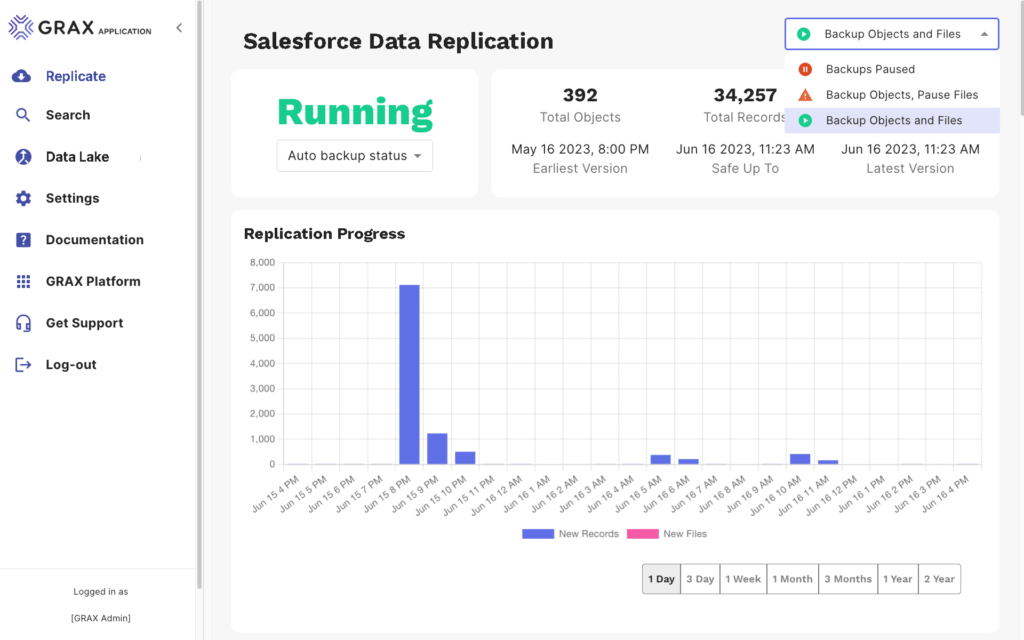
For both the GRAX cloud and self-managed model, the deployment process is very fast and once deployed, GRAX requires relatively little day-to-day administration. This is because processes such as backup, replication, and archiving usually run in the background, with a centralized dashboard giving organizations insight into backup activity, storage usage, and the overall health of the environment.
Gearset
Deployment in Gearset is completely different from GRAX. Gearset refers to deploying Salesforce metadata and changes from one environment to another: from sandbox to staging, from staging to production, and from version control to any org. This is essentially what Gearset was designed to do; there’s no infrastructure to provide, no cloud account to connect to, and nothing to install in the Salesforce org. It uses secure OAuth to enable connections to Salesforce and no access to or storage of credentials.
Gearset uses an intelligent metadata comparison engine, which gives teams a line-by-line picture of what exactly changed between the environments and the ability to deploy what they want precisely. The platform supports any Salesforce metadata covered by the metadata API, such as Agentforce, DataPacks, CPQ configuration, and Salesforce DX scratch orgs. With Gearset, every deployment is saved automatically, and there is a complete audit history of every change that occurs across all connected orgs.
Compliance, Governance, and Security
When organizations store sensitive customer data in Salesforce, compliance, governance, and security become legal operational requirements. As organizations grow and data volume expands, organizations need to be certain that their Salesforce platform and tools can protect sensitive data and also enforce the right controls.
GRAX
GRAX’s approach to compliance and security is not about a checklist of certifications but rather a foundational design. Its compliance model is built around data sovereignty. Storing organizations’ data on a customer-controlled cloud or on-premises environment allows organizations to decide how their sensitive data is stored, retained, accessed, and governed over time. This singular design eliminates an entire compliance risk that organizations face when trusting a third-party SaaS vendor with sensitive data.
GRAX has been audited to pass the SOC 2 Type 2 Compliance across its platform, and its Salesforce package also underwent and passed a rigorous security review by Salesforce. The platform supports a number of regulatory frameworks such as HIPAA (Health Insurance Portability and Accountability Act), GDPR (General Data Protection Regulation), and ISO/IEC 27001. All data on GRAX is encrypted in transit with TLS 1.2 and at rest with AES-256. The platform also gives role-based access controls, comprehensive audit logging, and configurable retention policies.
A distinctive compliance feature for GRAX is its digital chain of custody that maintains an auditable record of every version of all the records over time. It is very useful in organizations that operate under regulations that require detailed documentation of any change in data and long-term retention of history books.
These features position GRAX as a great option for organizations that need to show data ownership and auditability to regulators or internal governance teams and are not willing to rely on Salesforce’s native compliance infrastructure
Gearset
Gearset compliance and security structure is centered around two things: protecting customers’ sensitive data and ensuring that every action taken on the platform is completely audited and governed. The platform has been certified by external auditors to the international security standard ISO 27001 and also holds SOC 2 Type 2 attestation. That’s not all; Gearset instances and storage are hosted on AWS, which is the same data center trusted by facilities such as Heroku and Salesforce. These facilities hold SOC 1, SOC 2, SOC 3, HIPAA accreditations, PCI DSS level 1, and ISO 27001. The platform’s services run on a virtual private cloud inside AWS dedicated to it so as to further isolate its networks, with physical access to servers granted to authorized personnel only.
Gearset makes sure metadata and data are encrypted at all times, both in transit (uses TLS 1.2) and at rest (AES-256). In addition to the encrypted data, Gearset operates a 24/7 intrusion detection system that serves as protection against unauthorized access with logging analysis, policy monitoring, real-time alerting, and rootkit detection. Regular penetration tests by CREST-certified professionals also take place on the platform, with the results available on request.
Compatibility and Integrations
GRAX
The central idea of GRAX integrations is that your Salesforce data has to flow freely into any infrastructure or analytics tool being used. The platform integrates directly with major cloud providers such as Amazon Web Services S3 and S3-compatible storage, Azure, and GCP, making it possible for organizations to store and manage replicated data within the previously used cloud infrastructure. GRAX also supports customer-owned infrastructure across AWS, GCP, Azure, and on-premises environments for businesses with more specific requirements.
The platform automatically integrates data into Apache Parquet format, which is known for its strong compatibility with data engineering and analytical tool chains, which makes it easy to connect with Salesforce downstream tools such as BigQuery, Amazon Redshift, Snowflake, Databricks, and Azure Synapse. In addition to this, GRAX also integrates with Microsoft Fabric, which allows organizations to input Salesforce data directly into Azure’s Medallion Architecture for advanced analytics workloads.
Inside Salesforce, GRAX supports Salesforce Sales actors data, Clouds, Service Cloud, Government Cloud, Industry Clouds, and the core Salesforce platform. This makes it possible for organizations that manage many Salesforce orgs to consolidate backup and archiving operations through one GRAX deployment and also accommodate cross-org reporting and analytics.
Gearset
Gearset prides itself on having a very strong integration ecosystem, which is built to slot in tools that enterprise development teams already rely on instead of requesting they change how they work. The platform integrates with many major Git hosting providers, testing solutions, and messaging tools. Gearset can also connect to virtually any Git-based version control system, which can either be self-hosted or provided by any of the major providers. This gives room for teams to be flexible irrespective of their previous setup.
Gearsets are used in project tracking and collaboration. They integrate with Atlassian Jira to create and update tickets with detailed deployment information and also with Slack to send out notifications on the status of unit tests, CI jobs, and change monitoring.
Gearset is compatible with different Salesforce environment types within its CI/CD workflows and pipelines. This wide range of compatibility makes it a great option for teams that operate a traditional sandbox-based development and those that have implemented a fully Git-first Salesforce DX workflow.
Salesforce Data in Snowflake, BigQuery, or Redshift? Done.
GRAX stores everything in Parquet so your analytics stack can use it today.
Automation and Workflow Efficiency
GRAX
GRAX has automated major data operations that would have previously required a great amount of human effort to manage at the enterprise level. After configuration is done, the platform replicates Salesforce data to the customer’s cloud environment, and it automatically reattempts failed backup attempts to make sure there is consistency. GRAX automation abilities do not leave data retention and archiving out of the picture. It allows businesses to create lifecycle rules that automatically remove old records from the production environment based on already established criteria.
In addition to this, GRAX automates sandbox seeding, which makes it easy for development and QA teams to populate sandbox environments with realistic production data. GRAX also improves workflow efficiency by using automated data pipeline integrations, which move Salesforce data into analytics, reporting, and several business intelligence platforms. What this does is reduce manual steps involved in extracting, preparing, and transferring data for downstream business use.
Gearset
At the core of Gearset’s design is automation. Automated tests, validations, and deployments are performed by CI/CD on a periodic basis or after new work is committed to version control. Small changes are made and continuously integrated into the target environments without the need for manual and repetitive steps.
The creation of a release pipeline in Gearset is purely intuitive and requires no special resources dedicated to it. Teams are able to build a CI/CD pipeline by making use of a drag-and-drop interface, backpropagation, using a few clicks to promote changes, and making use of Gearset to automatically open pull requests to neighboring environments.
Gearset removes manual steps that slow down releases while respecting organizations’ compliance and approval processes. It achieves this with enterprise teams that manage a high volume of changes because its continuous delivery rules allow teams to define trusted conditions such as validations passed, code reviewed, or tests succeeded. Once the conditions are met, Gearset automatically promotes the changes. Additional automation includes the reduction of merge conflicts through Gearset’s intelligent merge algorithm, automated PR prioritization, and automated updates to user stories and ticketing tools as work moves on through the pipelines.
Community Support and Training
GRAX
GRAX provides technical customer support through its email and an in-app web form, with its agents responding from 9 am to 5 pm EST on US business days. In the event of critical business emergencies involving a complete loss of GRAX’s services or a major feature degradation in a production org, GRAX makes its bridge assistance available as quickly as possible. GRAX offers a premium support tier that organizations that need round-the-clock coverage can subscribe to. This offers access to technical support 24 hours a day, 7 days a week, 365 days a year.
The critical production issues get their first response within 4 hours for businesses subscribed to the Standard plan and 2 hours for those under the Premium plan. Less urgent requests, on the other hand, usually receive responses within 12 -14 hours under the Standard plan and 6-12 hours under the Premium plan.
The platform also takes the initiative to proactively reach out to customers about deprecations, best practices, and known issues. For new features and UI changes, training will be provided through documentation or live demos, with system changes available on the GRAX documentation hub within seven business days of their release.
GRAX also provides a knowledge base and technical documentation that covers different areas, including platform setup, configuration, backup and recovery, archiving, data pipelines, and other administrative functions. These resources provide organizations with guidance for both initial deployment and ongoing platform management.
Gearset
The support model on Gearset is one of the most praised aspects of the platform. It offers access to a real support team via live chat across all subscription tier levels. Support engineers do more than resolve issues; they also advise teams on designing and improving their release processes. They treat each customer engagement as a unique consultation rather than just a ticket to close.
For training, Gearset designed DevOps Launchpad, which is a free training platform for anyone in the Salesforce ecosystem. The platform also includes a structured onboarding toolkit with courses that walk users through the initial setup, DevOps concepts, key features, and functionality, which are all hosted on the DevOps Launchpad. Gearset publishes blogs regularly, hosts live and recorded webinars, podcasts, and interviews featuring DevOps experts in the Salesforce ecosystem through the Launchpad.
The combination of customer support, structured training, and readily available community education makes Gearset one of the most advanced learning ecosystems of any Salesforce vendor.
User-friendliness
GRAX
GRAX is designed to be straightforward for most of its functions. After the initial cloud infrastructure setup is complete, most of the day-to-day operations are automated and require little hands-on management. Users who previously spent a considerable amount of time downloading dozens of backup files every week describe the switch to GRAX as transformative, as the process has been reduced to selecting objects and scheduling a job.
GRAX provides Lightning components such as record views, restore wizards, and search tools, which are embedded into the Salesforce UI for day-to-day users who never leave Salesforce, and the components require no additional training. It makes use of a centralized dashboard to allow its users to monitor backup status, storage usage, and platform activity without requiring technical expertise in routine operations.
Gearset
Despite Gearset’s depth of functionality, it is still constantly described by users as approachable. It has a user-friendly interface, which makes it accessible to trainees and junior members. The platform simplifies complex tasks like deploying dependencies, resolving merge conflicts, and creating pull requests.
There is nothing to install in Salesforce orgs as its setup is handled entirely through OAuth and creates a release pipeline that requires no dedicated resource to maintain.
Each subscription tier makes use of live human support and holds a customer rating of 4.9 out of 5. The combination of the platform’s powerful tooling and low barrier to entry makes it one of the common themes across its user reviews.
Target audiences and user ratings
GRAX
GRAX works with a wide range of organizations from mid-size businesses to large enterprises, nonprofit and government organizations, across industries such as hospitality, financial services, travel, retail, manufacturing, and the legal sector. The platform is a good option for organizations where data ownership, compliance, and the ability to reuse Salesforce data in analytics environments are primary concerns.
Customer Ratings:
There are no public ratings available for GRAX on either G2 or Capterra
Gearset
Gearset can be used by midmarket and enterprise organizations across regulated and non-regulated industries. These include: financial services, healthcare, technology, and insurance. It is typically used by Salesforce administrators, DevOps engineers, developers, release managers, and platform owners responsible for maintaining security, development quality, and operational consistency.
Customer Ratings:
- 4.7-star rating (based on 215 verified reviews)
Potential shortcoming
GRAX
Before you consider using GRAX, it is important to be aware of the following potential shortcomings;
- The need for organizations to provide and manage their own cloud infrastructure brings about additional setup costs and technical overhead, especially for organizations that do not have an existing cloud environment like AWS, GCP, or Azure.
- Its design is narrowly scoped as it does not offer DevOps, CI/CD, deployment tooling, code review or automated testing. As such, organizations that need lifecycle management and release management will be required to run GRAX alongside a distinct DevOps platform.
- The day-to-day operations of GRAX are largely automated; the initial configuration process requires higher technical requirements, which may necessitate dedicated IT resources to effectively complete.
Gearset
Below are some of the shortcomings of Gearset that should be considered before using the platform;
- The modular pricing structure is a major concern among users and analysts. Each capability (deployments, CI/CD, backup, code review, observability) is licensed separately; as such, the total cost for a full platform deployment can escalate beyond what a normal entry-level subscription should cost.
- Some users also noted some inconsistencies with the overall application; for example, CI jobs for scratch org creation can be shared with team members, but normal CI jobs cannot be shared.
- Salesforce has its own DevOps center available that comes at no extra cost; teams with simpler deployment needs will reconsider whether Gearset’s pricing is justified.
Who Should Use GRAX vs. Gearset
Use GRAX if
GRAX is the right fit for organizations where data ownership, governance, and long-term data strategy sit at the center of the conversation, not as supporting concerns, but as the primary driver behind every Salesforce decision. Teams that treat their CRM data as a strategic asset, rather than a byproduct of daily operations, will find that GRAX was built specifically for them.
GRAX is relevant for organizations operating in regulated industries. In healthcare, financial services, legal services, and the public sector, the ability to prove what happened to Salesforce data and precisely when it happened is not just a best practice; it is a legal and operational requirement. GRAX provides that traceability natively, with an unbroken digital chain of custody that holds up against the most demanding compliance and audit scrutiny.
Beyond compliance, GRAX makes practical sense for any organization whose Salesforce org has grown large enough that storage costs and performance are becoming real concerns. Moving inactive records out of production without losing access to them is exactly what GRAX’s archiving capability is designed to do: cleanly, automatically, and without disrupting the teams who still occasionally need to reference that data. And for organizations with a data team that wants to go further by feeding historical Salesforce records into Snowflake, BigQuery, AWS SageMaker, or similar platforms for reporting, analytics, or AI and machine learning workflows. Not only that, GRAX removes the complex ETL work that would otherwise stand between CRM history and actionable business intelligence.
Use Gearset if
Gearset is the right fit for organizations where the priority is accelerating and governing the Salesforce development and release process. If the team is spending more time managing deployments than shipping value, dealing with failed releases, manual handoffs, or the constant anxiety of a change breaking production. Gearset provides the structured, automated path from development to when it goes live. This removes that friction and replaces it with a repeatable, governed process.
Gearset works for teams working across multiple Salesforce orgs or managing complex release trains where coordination between environments is a daily challenge. When compliance requirements like SOX, HIPAA, or GDPR need to be enforced not just at the data level but at the release level, with audit trails, role-based approvals, and documented change control for every deployment. Gearset builds that governance directly into how the team works, rather than asking them to manage it separately.
For teams that have accumulated a fragmented toolset over time, one tool for version control, another for testing, another for deployments. Gearset offers a compelling consolidation. CI/CD, code review, automated testing, and sandbox management all live within the same platform, reducing context switching, simplifying onboarding, and giving leadership a single source of truth across the entire release lifecycle.
And for teams that are still early in their DevOps journey, Gearset is approachable enough to get started quickly without sacrificing the depth needed to scale. Admins, developers, and release managers can all work within it from day one, and the platform grows in capability as the team’s maturity grows alongside it.
Conclusion
GRAX and Gearset are both great platforms designed for the Salesforce ecosystem. They are, however, not interchangeable, and as such, there is a need to do an honest assessment of what problem the organization is trying to solve before deciding on a platform.
GRAX is centered around protecting Salesforce data, making it your infrastructure and ensuring it is available for compliance, governance and downstream analytics. Gearset, on the other hand, is a generalist DevOps platform; it has deep enterprise-grade abilities across the full release lifecycle, deployments, CI/CD, testing, code reviews, sandbox management, and backup, all in one place.
For organizations in industries that are regulated, where data ownership, audit readiness, and the ability to reuse historical Salesforce data are important, GRAX delivers capabilities that no DevOps platform can replicate. For Salesforce development teams that need to ship changes faster and more efficiently with full governance across complex multi-org environments, Gearset is perfect.
In the case of organizations that are large and have both needs, both platforms can be complementary; one governing the data layer and the other the release layer. Deploying both will also put the organization at the full spectrum of Salesforce risk. What ultimately determines the platform to go for is determining your priority and the platform that provides a solution to the need.
Ready to Own Your Salesforce Data?
Start a free trial and see GRAX running in your own cloud environment.