Salesforce holds some of the most important data in modern organizations, including customer records, transaction histories, and operational workflows. Safeguarding that data while maintaining compliance and managing platform changes at scale are challenges that no single native tool fully solves.
GRAX and Flosum are Salesforce-focused solutions that help organizations to address these challenges. They both support data protection and governance requirements. However, they take different approaches that produce different outcomes depending on what your organization actually needs.
This comparison aims to examine both solutions across important areas such as backup and recovery, compliance, deployment, and user experience to provide you with a comprehensive understanding of how each solution works and which one is the right fit for your organization.
See What Full Salesforce Data Ownership Looks Like
GRAX stores your data in your cloud. See how it works in 7 days free.
GRAX vs Flosum
Before going over how GRAX and Flosum compare across specific areas, it is important to first understand what each solution is and what they were designed to do in the Salesforce ecosystem.
GRAX
GRAX is a Salesforce-native data management platform that helps organizations back up, archive, and reuse their historical Salesforce data. The main focus of this platform is to help address some of Salesforce’s limitations that are associated with data retention, accessibility, and long -term management by providing organizations with a more scalable and cost-effective way to store large volumes of historical Salesforce data while maintaining access to that information when it is needed.
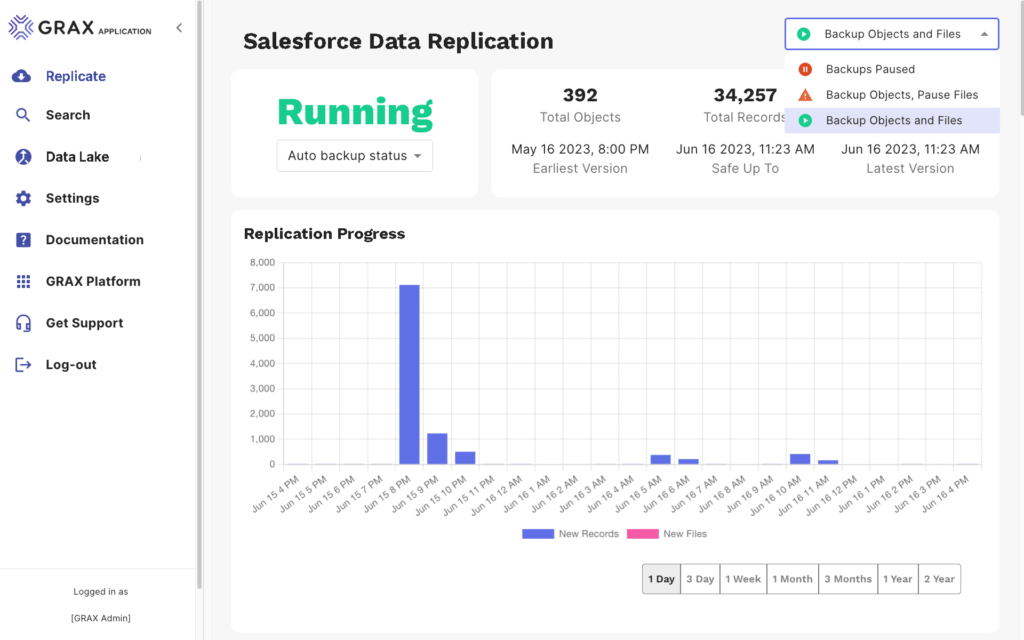
GRAX helps to keep Salesforce data accessible for longer periods by continuously replicating Salesforce data to a cloud storage environment that is managed by the customer, including AWS (Amazon Web Services), Azure, and GCP(Google Cloud Platform), or an on-premises environment. This enables organizations to maintain direct, long-term access to their data while also ensuring that information is accessible for compliance, reporting, auditing, and strategic decision-making long after its immediate operational use has passed.
Flosum
Flosum is a Salesforce DevOps platform that helps enterprise-scale organizations to manage, secure, and govern their Salesforce environments. The platform was created to help solve the challenges that come along with Salesforce development environments, where multiple teams, frequent releases, and strict compliance requirements can make it difficult to maintain visibility and control over changes. It combines all the activities involved in building, deploying, securing, and managing Salesforce applications within a single platform.
Flosum operates entirely within Salesforce, making it possible for organizations to leverage the platform’s existing security architecture while maintaining tighter control over their development and release processes. This enables teams using Flosum to manage their version control, automate deployments, strengthen governance, and support compliance requirements without relying on external tools or infrastructure.
Pricing and Features
GRAX
Aside from the 7-day free trial, GRAX offers 2 different plans on its website:
- Continuous Plan
- Continuous + Intelligence Plan
The price for these 2 plans is custom-quoted and is not publicly available on GRAX’s official website. Organizations interested in either plan usually have to schedule a consultation with the GRAX team to receive a quote based on factors such as data volume, retention requirements, deployment preferences, and the capabilities required.
GRAX provides capabilities such as continuous backup, point-in-time recovery, granular recovery, sandbox seeding, and on-platform insights. The platform also supports data pipeline integrations, allowing organizations to move their Salesforce data into external analytics, reporting, and business intelligence environments for broader business use.
Flosum
Flosum offers a product demo and a “Get Started For Free” option that allows prospective customers to explore the platform before making a purchasing decision. Aside from this, Flosum does not offer any plans or publicly disclose any detailed pricing information on its website. Organizations interested in the platform have to contact the company directly for a custom quote based on factors such as the number of users, deployment requirements, Salesforce environment complexity, and the capabilities required. Flosum pricing is reported to start from $300 USD per user per month, making it a solution that is positioned for organizations with complex Salesforce environments and the resources to support a dedicated DevOps platform.
Flosum provides a comprehensive set of Salesforce development lifecycle management capabilities that includes version control, CI/CD (Continuous Integration/Continuous Deployment), Salesforce release management, backup, and security controls. These features exist within a Salesforce-native platform and are configured to help organizations to manage their Salesforce development lifecycle more efficiently while maintaining governance and reducing deployment risks.
Long-term cost of ownership for GRAX and Flosum
The initial price of a software solution only provides half the picture. It is important for organizations to also consider the long-term costs that are associated with deployment, infrastructure, administration, scalability, and ongoing maintenance when evaluating the total cost of ownership of a platform.
With GRAX, the total cost of subscription goes beyond the platform’s subscription itself. With the platform storing replicated data in a customer-controlled cloud or on-premises environment, organizations also have to account for the associated infrastructure costs. For organizations that already operate on AWS. Azure or GCP, this may not represent a significant additional expense. However, organizations without an existing cloud infrastructure may need to factor these costs into their overall investments. GRAX, at the same time, can help to reduce Salesforce storage costs by moving older data out of the production environment, which may help offset some of those expenses over time.
With Flosum, the cost structure is generally more centralized because the platform operates entirely within Salesforce and does not require separate cloud infrastructure. However, organizations should consider that access to certain features may depend on the specific package or modules purchased. As the Salesforce environment grows in complexity and additional functionality is required, the overall investment may increase accordingly.
Ultimately, the long-term cost of ownership depends on an organization’s priorities. GRAX can be a cost-efficient solution for organizations that are primarily focused on Salesforce data protection, retention, and historical Salesforce data management. Organizations looking for a platform that combines DevOps, governance, compliance, and data protection capabilities may find Flosum’s investment justifiable.
Not Sure Which Plan Fits?
Talk to GRAX and get a quote built around your actual data needs.
Backup, Recovery, and Archiving Capabilities
GRAX
GRAX has a very strong backup and recovery system that continuously replicates Salesforce data, metadata, files, attachments, and custom objects into the customer’s own cloud environment, creating a complete and up-to-date copy of the Salesforce environment. This approach supports granular point-in-time recovery, which allows organizations to restore a single record, a specific object, or an entire org state to any point in the past without having to recover everything at once.
For long-term storage, GRAX provides archiving capabilities that automatically move older data out of the production environment based on defined retention policies. The archived data remains accessible and searchable, making it important for organizations that need to meet regulatory retention requirements without inflating their Salesforce storage costs.
Flosum
Flosum carries out its backup using the Composite Backup. Instead of running traditional comprehensive and incremental backup cycles, Composite Backup continuously captures new, changed, and deleted Salesforce data and combines it with previously backed-up information to maintain a complete backup state. This method helps to streamline the overall backup storage process while also reducing storage overhead.
Flosum supports flexible storage destinations, including customer-managed cloud environments, self-hosted, and on-premises options. Additionally, Flosum provides granular recovery capabilities that allow organizations to restore specific records when needed. Through features that allow teams to temporarily disable automations such as Flows, Workflows, and Validation Rules, Flosum provides organizations with the option of restoring data without triggering unintended business processes during recovery.
Point-in-Time Recovery, No Limits on History
See how GRAX continuous replication keeps every version of every record.
Deployment and Management
GRAX
GRAX is deployed within the customer’s own cloud environment, providing organizations with direct control over the infrastructure that stores their Salesforce data. The deployment process usually involves some initial configuration, especially for organizations that manage their own cloud resources, but much of the setup can be automated, depending on the deployment environment.
Once deployed, GRAX requires relatively little day-to-day administration. This is because processes such as backup, replication, and archiving are usually run automatically in the background, while a centralized dashboard provides organizations with visibility into backup activity, storage usage, and the overall health of the environment. So, while organizations might need to familiarize themselves with cloud infrastructure during initial deployment, the process of ongoing management is generally straightforward.
Flosum
Flosum is installed directly within Salesforce as a managed package, removing the need for separate infrastructure or external environments. This architecture helps to simplify deployment, especially for organizations that are already familiar with Salesforce’s administration. However, implementation may require additional planning in larger environments where multiple teams, Salesforce orgs, and established development processes need to be incorporated into the platform. Once configured, Flosum provides a centralized environment for managing development, governance, and compliance activities.
Compliance, Governance, and Security
While GRAX and Flosum provide capabilities that support compliance and security requirements, the way those capabilities are implemented reflects the different problems that each platform was designed to solve.
GRAX
GRAX builds its compliance model around data storage control. It stores an organization’s Salesforce data within a customer-controlled cloud or on-premises environment, giving organizations direct control over how their data is stored, retained, accessed, and governed over time.
GRAX provides enterprise-grade encryption for data in transit and at rest, role-based access controls, comprehensive audit logging, and configurable retention policies. The platform also supports a range of regulatory frameworks, including GDPR (General Data Protection Regulation ), HIPAA (Health Insurance Portability and Accountability Act), and ISO/IEC (International Information security stand) 27001.
One of GRAX’s most notable compliance features is its Digital Chain of Custody, which maintains an auditable record of every version of every record over time. This is especially valuable for organizations that operate under regulations that require detailed documentation of data changes and long-term storage of historical records.
These capabilities make GRAX a strong option for organizations that need to demonstrate data ownership and auditability to regulators, auditors, or internal governance teams without depending on Salesforce’s native compliance infrastructure.
Flosum
Flosum’s regulatory compliance and security model is centered on its Salesforce-native architecture. It leverages all of Salesforce’s existing security certifications and controls by default, including its support for GovCloud (Government cloud environment provided by Salesforce) and FedRAMP (Federal Risk and Authorization Management Program) environments. The platform also uses a zero-trust model where customer data remains accessible, even to Flosum personnel.
Flosum integrates governance into the development and release process through capabilities such as policy-based deployment, controls, audit trails, and change tracking. Flosum also incorporates security checks into the software release process, which helps organizations identify potential vulnerabilities and enforce governance requirements before changes are moved into production. This system helps organizations to maintain stronger governance while reducing the risk of compliance issues during software development and release activities.
Need an Audit Trail That Holds Up to Regulators?
GRAX Digital Chain of Custody tracks every record change, automatically.
Compatibility and Integrations
GRAX
GRAX integrates directly with major cloud providers, including AWS, Azure, and GCP, making it possible for organizations to store and manage replicated data within their existing cloud infrastructure. The platform stores data in Apache Parquet format, which is broadly compatible with data engineering and analytics tool chains, making it straightforward to connect Salesforce data to downstream tools such as BigQuery, Amazon Redshift, Amazon Athena, and Azure Synapse.
Within Salesforce, GRAX supports Sales Cloud, Marketing Cloud, Commerce Cloud, Industry Cloud, and custom Salesforce configurations. It also allows for organizations that manage multiple Salesforce orgs to consolidate backup and archiving operations through a single GRAX deployment while supporting reporting across multiple Salesforce environments and analytics.
Flosum
Flosum’s integration system is centered around the Salesforce ecosystem. It allows development teams to incorporate Flosum into existing workflows by supporting connections with popular DevOps and project management tools, including Jira, Git, Azure DevOps, and Selenium.
Flosum’s integration focus is more concentrated on the Salesforce and DevOps ecosystem when compared with GRAX. While this can be a constraint for organizations whose technology stack extends significantly beyond Salesforce, it provides deep, reliable compatibility for teams whose primary operational environment is Salesforce.
Automation and Workflow Efficiency
GRAX
GRAX automates the major data operations that would otherwise require significant manual effort to manage at the enterprise level. Once configured, the platform, without requiring intervention, continuously replicates Salesforce data to the customer’s cloud environment and automatically retries failed backup attempts to ensure consistency.
GRAX’s automation capabilities extend to its data retention and archiving, where it allows organizations to create automatic data retention rules that automatically move older records out of the production environment based on pre-established criteria. GRAX also automates sandbox seeding, making it easier for development and QA (Quality Assurance) teams to populate sandbox environments with realistic production data.
Additionally, GRAX improves workflow efficiency through automated data pipeline integrations that move Salesforce data into analytics, reporting, and business intelligence platforms. This helps to reduce the manual steps that are usually required to extract, prepare, and transfer data for downstream business use.
Flosum
Flosum allows organizations and teams to build CI/CD pipelines that help automate the movement of changes across Salesforce environments, helping development teams to move changes across Salesforce environments, from development, testing, and then into the production phase with less manual effort and human error that usually accompany Salesforce deployment.
Flosum’s automation capabilities also extend into areas such as deployment conflict detection, policy enforcement, and code quality checks. This allows governance and security requirements to be incorporated directly into the release process instead of being managed as separate manual activities. Organizations that manage multiple Salesforce environments and frequent release cycles use Flosum’s automation capabilities to reduce their deployment errors, improve their release quality, and accelerate the delivery of new changes.
Community Support and Training
As enterprise-focused Salesforce platforms, both GRAX and Flosum provide support, training, and educational resources to help organizations deploy and manage their solutions effectively. However, the structure and depth of these resources differ:
GRAX
GRAX provides customer support via email and an in-app web form, with their agents available from 9 am to 5 pm EST (Eastern Standard Time) on US business days. The platform offers standard and premium support plans, with their response times determined by the severity of the issue. The critical production issues receive an initial response within 4 hours under the Standard plan and 2 hours under the Premium plan, while less urgent requests usually receive responses within 12 -14 hours under the Standard plan and 6-12 hours under the Premium plan.
In addition to direct support, GRAX maintains a knowledge base and technical documentation that covers platform setup, configuration, backup and recovery options, archiving, data pipelines, and other administrative functions. These resources provide organizations with guidance for both initial deployment and ongoing platform management.
Flosum
Flosum provides customer support through its customer support center, which serves as a central hub for resolving issues, accessing troubleshooting guides, and connecting with its customer success and technical support teams. The platform also uses intercom to support self-service assistance through its documentation portal, while allowing users to connect directly with support personnel through chat when there is a need for additional help.
Like GRAX, Flosum also maintains a documentation library that covers the workaround of important features such as backup, archiving, restore operations, and other cloud applications. These resources allow teams to independently resolve common issues, learn platform functionality, and access implementation guidance without always relying on direct support channels.
User-friendliness
GRAX
GRAX is generally regarded as straightforward to use for its major functions. After the initial cloud infrastructure setup is complete, most of the day-to-day operations are automated and require minimal hands-on management. It uses a centralized dashboard to allow its users to monitor backup status, storage usage, and platform activity without requiring technical expertise in routine operations.
The initial deployment process may require some familiarity with cloud infrastructure, especially for organizations without an established cloud environment. However, once GRAX has been set up, the platform is considered easy to manage.
Flosum
Flosum’s user experience benefits majorly from its Salesforce-native architecture. The interface is intuitive, and it helps to reduce the time required to get comfortable with the platform, especially for administrators and developers who already work within the Salesforce environment.
Flosum’s broad functionality can create a steep learning curve, especially within large enterprise environments that involve multiple Salesforce orgs and complex permission structures. However, user feedback generally suggests that teams that invest time during the initial setup phase get more comfortable as they gain more understanding about the platform and its capabilities.
Target audiences and user ratings
GRAX
GRAX serves a broad range of organizations from mid-sized businesses to large enterprises, across industries including hospitality, retail, manufacturing, legal services, financial services, and non-profits. The platform is particularly well-suited for organizations with data-intensive Salesforce environments that require long-term data retention, compliance-grade archiving, or the ability to connect historical Salesforce data to external analytics and reporting tools.
Customer Ratings:
No public ratings available on either G2 or Capterra
Flosum
Flosum majorly serves large enterprises with complex Salesforce environments, active development teams, and regulated industry requirements. Its user base spans industries including information technology and services, financial services, healthcare, pharmaceuticals, and government, showing its position as a platform that is built for organizations that require DevOps and compliance capabilities.
Flosum’s Customer Ratings:
| Feature | GRAX | Flosum |
| Backup | ✔️ | ✔️ |
| Archiving | ✔️ | Limited |
| DevOps | No | ✔️ |
| CI/CD | No | ✔️ |
| Compliance | ✔️ | ✔️ |
| Sandbox Seeding | ✔️ | Limited |
Potential shortcomings
GRAX
Here are some shortcomings that users looking into GRAX should be aware of:
- The platform’s architecture requires organizations to provision and manage their own cloud infrastructure, which brings about additional setup costs and technical overhead, particularly for teams that have no pre-existing cloud environment on AWS, Azure, or GCP.
- While the day-to-day operations are largely automated, the initial configuration process usually requires higher technical requirements that may require dedicated IT resources to effectively complete.
- GRAX’s capabilities are focused primarily on data lifecycle management. The organizations that also require DevOps, release management, or deployment governance capabilities will likely have to get additional tools to serve their needs
Flosum
Flosum’s shortcomings include:
- The initial setup and configuration process can be time-intensive, especially in large-enterprise environments with multiple Salesforce orgs, complex permission structures, and established development workflows.
- Flosum operates entirely within Salesforce and, as such, may be subjected to Salesforce platform and governance limits, which may affect performance in environments with high levels of activity or complexity.
- Flosum’s modular pricing structure allows for certain capabilities to be priced separately from the main platform, making the total cost estimation less straightforward during the evaluation process
Ready to Own Your Salesforce Data?
Start a free 7-day trial and see GRAX in your own cloud environment.
Use GRAX If
Use GRAX if your organization’s main objective is to protect, retain, and manage Salesforce data over the long term. It is particularly well-suited for organizations that are comfortable operating in cloud environments such as AWS or Azure and want to store replicated Salesforce data within their own infrastructure instead of relying on a third-party environment.
GRAX is also a great fit if your organization needs to connect historical Salesforce data to external analytics, reporting, or machine learning tools, or prioritizes reducing Salesforce storage costs through archiving. Furthermore, GRAX’s compliance model and Digital Chain of Custody make it a compelling option for organizations that operate in regulated industries where data storage control, detailed audit trails, and long-term storage documentation are important requirements.
Essentially, GRAX works best for organizations that want full ownership and control over their Salesforce data with the flexibility to put that data to work beyond the boundaries of the Salesforce platform.
Conclusion
GRAX and Flosum are both strong platforms within the Salesforce ecosystem, but they are built for different purposes, and they serve different organizational needs.
GRAX is the stronger fit for organizations whose primary concern is to protect robust volumes of Salesforce data, maintain long-term storage for compliance, reduce storage costs through archiving, or feed historical Salesforce data into analytics and reporting pipelines.
Flosum, on the other hand, works for organizations that want to manage the full development and release lifecycle, enforcing compliance controls within the deployment process and maintaining visibility and control across complex multi-organization environments.
In some enterprise environments, these 2 platforms can complement each other with GRAX handling data lifecycle management and Flosum supporting DevOps governance. However, for most organizations, the decision to choose the right solution depends on the challenge they are trying to solve.